


Send Message
Privacy statement: Your privacy is very important to Us. Our company promises not to disclose your personal information to any external company with out your explicit permission.
 Dongguan Zhenying Machinery Equipment Co., LTD
Building a silicone heat transfer label production line requires more than purchasing a single machine. Manufacturers need to coordinate production equipment, molds, silicone materials, processing procedures, quality inspection, and operator training.
A suitable production line should match the factory's product types, order volume, available space, and quality requirements.
For manufacturers entering the silicone garment label market or expanding existing production, a well-planned setup can help improve process consistency and reduce unnecessary investment.
A silicone heat transfer label production line typically requires:
Silicone material preparation and mixing equipment, where required
Silicone dispensing or application equipment
Label molds and tooling
Vacuum degassing equipment, depending on the process
Heating and vulcanization equipment
Transfer application equipment or a suitable heat press
Cooling, trimming, and finishing tools
Quality inspection equipment
The exact configuration depends on the silicone formulation, label design, production capacity, and whether different manufacturing stages are integrated into one machine or handled separately.
Before selecting equipment, determine what types of silicone labels you intend to manufacture.
Common products include:
Sportswear logos
Silicone garment labels
Clothing patches and badges
Footwear branding elements
Decorative silicone labels
Multi-color silicone logos
Next, confirm the main production requirements:
| Requirement | Information to prepare |
| Product design | Label drawings, samples, colors |
| Product dimensions | Length, width, and thickness |
| Material | Silicone formulation and adhesive system |
| Fabric application | Polyester, cotton, nylon, or blended fabric |
| Production volume | Daily and monthly output targets |
| Quality requirements | Adhesion, flexibility, appearance, washing resistance |
These details help determine the machine type, mold structure, and production process.
The main equipment should support the actual manufacturing process.
dispensing machine is used to apply silicone material into mold cavities or onto designated areas. For multi-color labels, dispensing accuracy and color separation are important considerations.
Vacuum Processing Equipment
Vacuum processing may be used to remove trapped air from silicone materials or support specific production processes. Its necessity depends on the material and manufacturing method.
Heating and Vulcanization Equipment
Controlled heating is used to cure or vulcanize silicone materials. Temperature stability, heating uniformity, and processing time affect production consistency.
Heat Transfer Equipment
A suitable heat press or transfer system applies the required temperature and pressure to bond the finished silicone label to the target fabric.
Some production systems integrate several functions into one machine, while others use separate equipment for different stages.
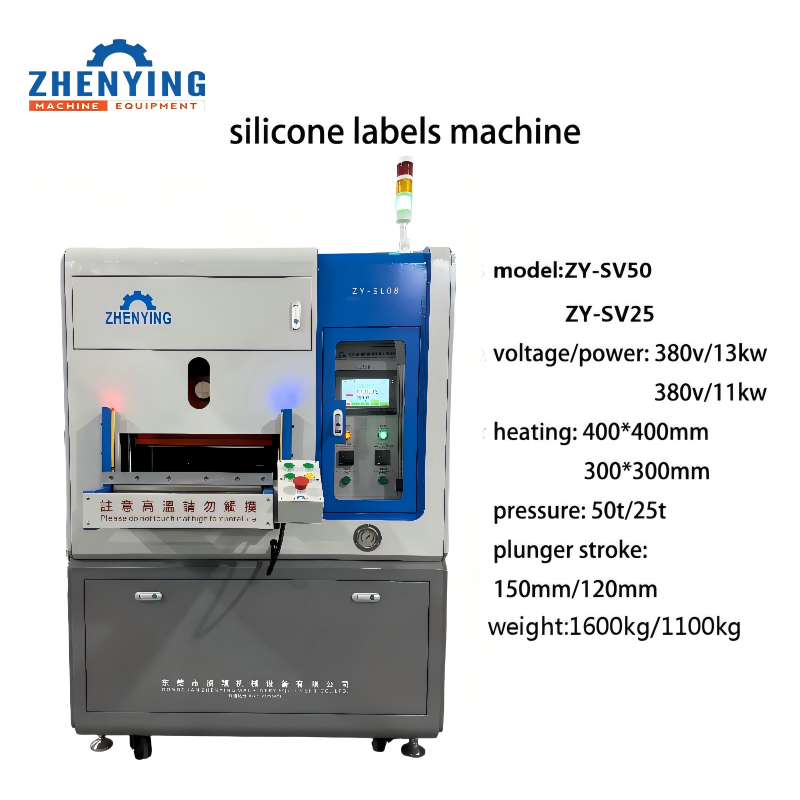
Molds are essential for determining label shape, dimensions, surface details, and product consistency.
When designing molds, consider:
Product geometry and thickness
Number of colors
Material flow and filling paths
Venting requirements
Demolding method
Compatibility with the selected machine
For multi-color silicone labels, mold design should also consider the sequence of material application and the prevention of color contamination.
A suitable mold can improve production repeatability and reduce defects caused by poor filling or difficult demolding.
A typical silicone heat transfer label production process may include the following stages:
Step 1: Material Preparation
Prepare silicone materials according to the formulation and supplier instructions. Mixing ratios and material handling should be controlled.
Step 2: Mold Preparation
Clean and inspect the mold. Confirm that it is correctly installed and suitable for the product design.
Step 3: Silicone Dispensing
Apply silicone material into the mold according to the required pattern, volume, and color sequence.
Step 4: Vacuum Processing, If Required
Use vacuum processing when the selected material and process require air removal.
Step 5: Heating and Vulcanization
Apply the specified temperature, pressure, and curing time to form the silicone label.
Step 6: Demolding and Finishing
Remove the cured label carefully. Complete trimming or other finishing operations where necessary.
Step 7: Heat Transfer Application
Apply the appropriate adhesive system and transfer the label to the target fabric under validated conditions. Some production processes perform adhesive application at an earlier stage.
Step 8: Quality Inspection
Check appearance, dimensions, adhesion, flexibility, and other customer-specific requirements.
The actual sequence may vary depending on the silicone formulation, mold design, and machine configuration.
Production capacity depends on more than machine speed.
Important factors include:
Number of mold cavities
Dispensing cycle time
Vulcanization time
Loading and unloading time
Mold changeover frequency
Operator workflow
Defect and rework rates
For example, a production line with multiple cavities may produce more labels per cycle, but only if filling, curing, and demolding processes can support the increased output.
Staffing should also be based on actual workflow. One operator may manage several machines in some configurations, while more complex processes may require separate operators for material preparation, machine operation, finishing, and inspection.
Conduct a production trial before confirming staffing and output targets.
Quality control should cover both label manufacturing and final fabric transfer.
| Production stage | Main inspection points |
| Material preparation | Mixing ratio and material condition |
| Dispensing | Filling volume and color consistency |
| Vulcanization | Temperature, pressure, and curing time |
| Demolding | Shape, surface, and edge condition |
| Heat transfer | Adhesion and fabric compatibility |
| Final inspection | Appearance, dimensions, flexibility, and durability |
Keep production records for material batches, mold versions, machine settings, and inspection results.
This helps manufacturers identify process variations and reproduce approved production conditions.
Not every factory needs a fully automated production line from the beginning.
| Production setup | Suitable situation |
| Basic or manual setup | Samples, small batches, and frequent design changes |
| Semi-automatic setup | Growing orders and a need for improved process consistency |
| Integrated or more automated setup | Stable repeat orders and clearly defined production processes |
Before investing, compare equipment cost, available space, labor requirements, maintenance, expected utilization, and future product plans.
A modular setup can be a practical approach: start with the essential equipment and add automation when production demand justifies it.
Zhenying Machines manufactures PVC and silicone soft-rubber processing equipment, including silicone heat transfer label production machinery.
Beyond equipment, Zhenying can provide mold support, material guidance, and technical assistance to help manufacturers evaluate their production requirements.
The appropriate solution depends on the customer's label samples, product dimensions, material system, production volume, and factory conditions.
When requesting a production line proposal, provide product drawings or samples, target output, fabric types, and existing production equipment. This information helps determine a suitable equipment configuration.
A silicone label production line requires coordinated equipment, molds, materials, and process control.
Machine configuration should match the actual label design and production volume.
Vacuum processing and integrated functions depend on the selected manufacturing process.
Production capacity must account for curing time, mold cavities, handling, and changeovers.
Quality inspection should cover both silicone label production and final fabric transfer.
Semi-automatic or modular production may be more practical than full automation for some factories.
Planning a silicone heat transfer label production line? Contact Zhenying Machines with your product samples, production targets, and factory requirements to discuss a suitable equipment solution.
Q1: What machines are needed to manufacture silicone heat transfer labels?
Depending on the process, manufacturers may need silicone dispensing equipment, molds, material preparation tools, vacuum equipment, heating and vulcanization equipment, and heat transfer equipment.
Q2: Can one machine complete the entire silicone label production process?
Some machines integrate multiple processing functions, but not every production stage is necessarily completed by one machine. The configuration depends on the product and manufacturing process.
Q3: How much space is needed for a silicone label production line?
Space requirements depend on machine dimensions, material storage, mold handling, operator access, finishing operations, and product inspection areas. A factory layout should be prepared before equipment installation.
Q4: How many workers are needed for silicone label production?
Staffing depends on the degree of automation, production volume, number of machines, and workflow. A production trial is the best way to estimate actual labor requirements.
Q5: Should a new factory choose a fully automatic production line?
Not necessarily. A basic or semi-automatic setup may be more suitable for small batches and frequent product changes. Automation can be introduced as order volume and process stability increase.

November 26, 2026
Email to this supplier
November 26, 2026

Privacy statement: Your privacy is very important to Us. Our company promises not to disclose your personal information to any external company with out your explicit permission.
Fill in more information so that we can get in touch with you faster
Privacy statement: Your privacy is very important to Us. Our company promises not to disclose your personal information to any external company with out your explicit permission.